
A company brain is your business's central memory: processes, price lists, rules and documents gathered into one ordered archive, built with tools like Obsidian. When AI automations read from this base, they stop making things up: they answer using your company's real data. It's the most effective way to reduce errors and hallucinations.
What a company brain is (and why everyone's talking about it)
The company brain is the business version of the "second brain": a single ordered archive where the information that runs your company lives, price lists, sales terms, processes, template answers, document templates. Tools like Obsidian make it simple: linked pages, plain text files that remain the company's own property.
The idea comes from the second brain method popularised by Tiago Forte's book, a global phenomenon with millions of readers and viewers across productivity channels. Applied to a business, the idea changes scale: it's no longer one person's personal archive, but the organisation's shared memory, the one that never goes on holiday, never forgets anything and never changes its version of the facts.
Why AI without context makes things up
AI tools generate answers from what they've learned in general, not from what your company actually knows. When the right information is missing, they don't stop: they produce the most plausible answer. That's the hallucination phenomenon, answers written with confidence, but wrong. The remedy is giving AI verified company knowledge.
The problem is documented and serious. A Stanford University study on AI tools for legal research found error rates between 17% and 34%, even in specialised systems, with far higher rates for generic tools used without reference sources. And an international archive curated by researcher Damien Charlotin has already catalogued over 1,400 court cases where AI-invented legal citations appeared. These are extreme examples, but the mechanism is identical in every office: an outdated price in a quote, a warranty condition that doesn't exist in an email, a wrong deadline in a reminder.
The key point: it's not a flaw in the tool, it's a flaw in context. An automation that doesn't know where to find your real data works from memory, and memory, when it's missing, makes things up.
How a company brain cuts errors at the root
Connecting automations to your company's knowledge base changes how AI works: it first looks for the answer in your documents, then uses it to write. If the information is there, it's used faithfully and its source can be shown; if it isn't, the tool flags it instead of improvising. Errors become rare and, above all, verifiable.
This approach, pulling answers from certified company sources instead of the model's general memory, is today the industry standard, and this isn't Dedalix's opinion: it's confirmed by the technical guides from Google Cloud, the official overview from Microsoft on the architecture that connects AI to company knowledge bases, and the practical guide published on Towards Data Science. They all converge on the same point: the quality of the knowledge base is the main factor that determines how reliable the answers are. Anyone who wants the more technical detail will find it explained in these sources; here, the practical result is what matters, and it brings three concrete benefits:
- Consistent answers everywhere. Quotes, emails and documents all draw on the same information: one price, one warranty condition, for the whole team.
- One place to update. Price list changes? Update one page of the company brain and every connected automation uses the new figure right away.
- Control and traceability. Every answer can be traced back to the document it came from: whoever checks it knows exactly where to look.
Karpathy's method: the wiki that maintains itself
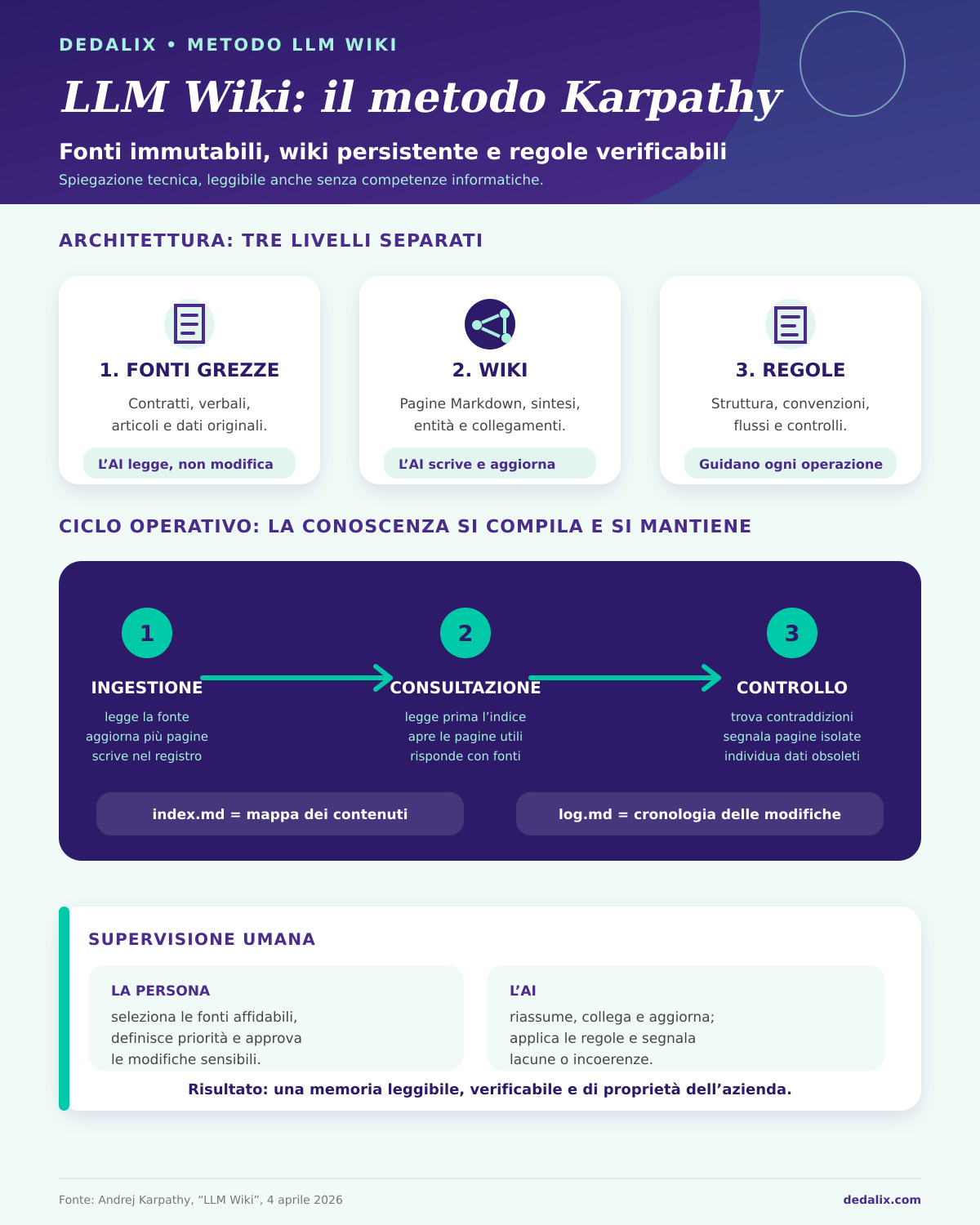
In April 2026 Andrej Karpathy, OpenAI co-founder and Tesla's former AI lead, published the «LLM Wiki» method: instead of having AI search through raw documents for every question, the AI itself builds and maintains an ordered knowledge wiki, one that grows with every new piece of information and stays permanently up to date.
His original document, which in a few weeks became one of the most shared references in the field, rests on three core principles:
- Three separate layers. Raw sources (documents, contracts, minutes) are untouchable: AI reads them but never edits them, they remain the source of truth. The wiki is the set of pages AI writes and keeps updated. And a rules document defines how the wiki is structured and maintained: it's what turns AI into a disciplined archivist rather than a generic assistant.
- Knowledge is compiled once, not rebuilt every time. When a new source arrives, AI reads it, extracts the key information and updates all the linked pages, flagging when new data contradicts old data. The result is an archive that grows richer over time, with the links and checks already done.
- Periodic maintenance. At regular intervals, AI runs a health check on the wiki: contradictions between pages, information superseded by more recent sources, disconnected pages, gaps to fill. This is exactly the maintenance that traditional company wikis die from, because no one ever has time to do it.
Dividing the roles is the heart of the method: the person chooses the sources and asks the right questions; AI does all the archive work, summaries, links, consistency. And it's no accident that Karpathy describes working with Obsidian open next to the AI tool: the wiki is made of simple text files, readable and owned by whoever holds them. It's confirmation, from the voice of one of the field's most authoritative figures, of the very principle the company brain is built on.
Three generations of AI memory: from RAG to LLM Wiki
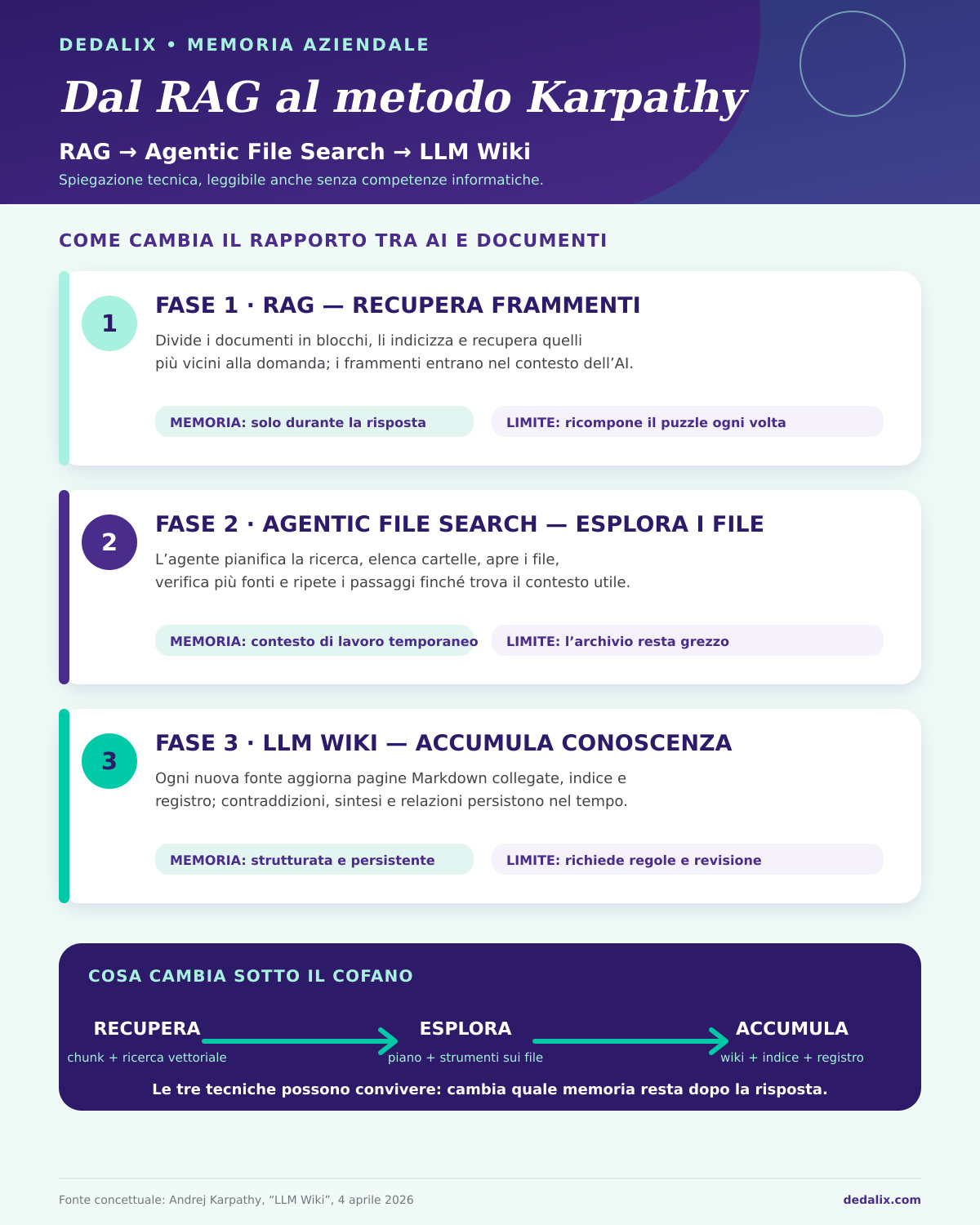
The way AI tools access company knowledge has gone through three increasingly advanced phases: retrieving fragments from documents (RAG, phase 1), an agent autonomously searching through files (agentic file search, phase 2), and the AI-maintained wiki proposed by Karpathy (LLM Wiki, phase 3). Understanding how they work explains why the third is what truly makes business automations reliable.
Phase 1 — RAG, fragment retrieval. RAG stands for «retrieval-augmented generation»: company documents are broken into small fragments and turned into a searchable index; for every question, the system retrieves the fragments most similar to the request and passes them to the AI tool, which answers based only on those. It's the most widespread technique and works well on large archives, but it has two structural limits: it works on isolated fragments, not the overall picture, and it accumulates nothing, every question starts from scratch. If the answer requires connecting information scattered across five documents, the puzzle has to be rebuilt every time, and quality depends on which fragments the system managed to "catch".
Phase 2 — agentic file search, the agent explores the files. Here AI doesn't receive preselected fragments: it acts as an autonomous agent that navigates folders, opens files, reads them and decides where to look, the way a colleague who knows where to dig would. It captures context far better and can follow more elaborate search paths. But the knowledge stays raw and unstructured: no one organises it, no one reconciles two documents that contradict each other or flags that a piece of data is now outdated. The intelligence is in the search, not in the archive.
Phase 3 — LLM Wiki, the AI-maintained wiki. This is Karpathy's method described above, and it marks the real leap: AI doesn't just search, it builds. It reads sources once, extracts the knowledge and deposits it into linked pages, with a table of contents and a change log, then keeps it up to date with every new piece of information, reconciling contradictions as it goes. Answers cite the pages they come from, and a periodic check flags gaps and inconsistencies. The difference from the first two phases is clear: here the intelligence sits in the archive, not just in the search. This is the conclusion we see in our own projects: for a company's day-to-day operating knowledge, an ordered, maintained archive beats improvised searches through raw documents. RAG stays useful for huge, loosely structured archives; for the knowledge a business uses every day, the wiki wins.
A cross-sector method: it works for every industry
A company brain isn't a technique for tech companies: it's for anyone whose knowledge today lives scattered across emails, people's heads and folders. The fiduciary firm collects tax rates, deadlines and client practices in it; the tradesperson price lists, installation times and supplier terms; the real estate agency property files and rental-file rules; the medical practice protocols and template communications; the hotel cancellation policies and guest replies.
In every case the principle is the same: knowledge gets organised first, automation comes second. It's the same reason why, as we explained when discussing the risks of improvised automation, a well-run project never starts from the tool: it starts from the processes and the information that govern them.
Data safety: the company brain lives at home
Tools like Obsidian save everything as simple text files on the company's computer or server: no account required, nothing sent automatically to outside servers. For data protection this is a real advantage, the information stays physically where you decide, under the company's direct control.
This isn't our interpretation: Obsidian's privacy policy states that data is saved locally on the device, is not transmitted to the maker's servers and that no personal data is collected, the tool even works offline. It's the opposite of a typical cloud service, where company documents live on a third-party provider's servers, under terms that can change over time.
For a Swiss SMB this matters twice as much. The Federal Data Protection and Information Commissioner (FDPIC) has clarified that the nFADP applies directly to data processing involving artificial intelligence too: anyone using these tools needs to know what data they handle, where it ends up and for what purpose. A local archive makes these answers simple: you know exactly where the data is, who accesses it and what gets shared with AI tools, only the information that's needed, when it's needed, with business configurations that don't use client data for training.
An honest caveat: local doesn't automatically mean secure. You still need backups, access control, caution with third-party extensions and clear rules on what information gets connected to AI tools. This is exactly the kind of configuration we handle on every project, for law firms, fiduciaries and medical practices, nFADP compliance verification is part of the initial audit.
The AI Act has arrived: what changes for Switzerland too
In August 2026 most of the obligations under the EU AI Act become applicable, the world's first comprehensive law on artificial intelligence, in force since 2024 with staggered deadlines. Switzerland has chosen its own path: no single law, but ratification of the Council of Europe Convention and targeted, sector-specific rules.
Switzerland's direction is official: on 12 February 2025 the Federal Council decided to ratify the Council of Europe Convention on Artificial Intelligence and instructed the Department of Justice to prepare, by the end of 2026, a preliminary bill focused on transparency, data protection and non-discrimination. As the Swiss Federal Institute of Intellectual Property also explains, the approach will be sector-based: targeted measures where needed, not a copy of the AI Act.
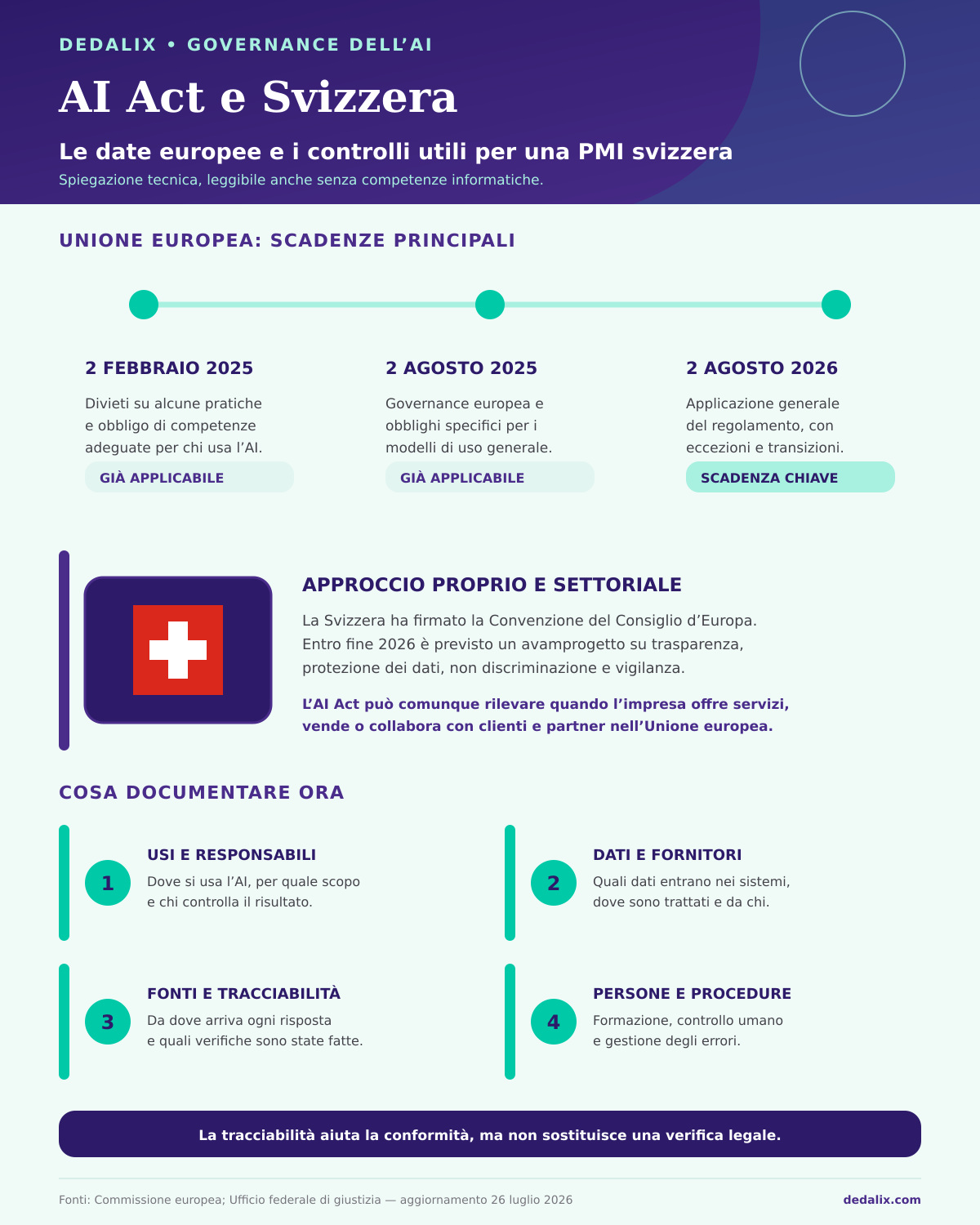
For a Swiss SMB the substance is this: even without a direct obligation, anyone working with clients or partners in the EU will have to reckon with the AI Act, and the incoming Swiss rules converge on the same principles. This is where everything we've covered so far stops being just good practice and becomes regulatory preparation. The threads of this article tie together in three points:
- Fewer hallucinations = less compliance risk. The new rules call for AI tools that are reliable and supervised. An automation that makes up a price or a warranty condition, the kind of error described at the start of this article, isn't just a commercial loss: it's exactly what the regulation is meant to prevent. A company brain cuts this risk at the root, because answers come from verified company documents, not the tool's general memory.
- The transparency being asked for is already built in. Transparency, to the people writing the rules, means being able to say where an answer came from. In a Karpathy-style wiki, every page states its sources and the change log documents what changed and when: the documentation that might be requested writes itself as you work. With fragment retrieval, the first phase covered above, this kind of ordered trail simply doesn't exist: every answer is born and dies the moment it's given.
- Control of the data is physical, not just contractual. The Convention Switzerland will ratify and the nFADP both converge on data control. With a local archive like Obsidian, the point covered in the previous section, you know where the data is, who accesses it and what gets shared with AI tools, without depending on a cloud provider's terms.
In other words: the company brain isn't an extra cost to comply with rules on the way. It's the same investment that eliminates errors and hallucinations, seen from the regulatory side — one piece of work, two results: reliable automations today, compliance ready tomorrow. Whoever builds it now arrives at the new rules without having to redo anything. What the AI Act covers, how Switzerland is adopting it, and what it means in practice for an SME, we've covered in detail in our dedicated article on the AI Act and its impact on Swiss SMEs.
The Dedalix method: the company brain is the standard, not an extra
In every Dedalix project, building the company brain is the first step, not an option: we map the information the automations will need to use, verify it with the client and organise it into an ordered knowledge base, owned by the company. Only then do we connect the automations. It's our standard method because it's what keeps results reliable over time.
Already have automations running? No problem, in fact it's one of the interventions with the fastest payoff. We start from what exists, map the information the automations use today, fill the gaps and connect the knowledge base. The automations stay the same but start answering with your company's real data, and the quality of the results improves right away. With the SCALE plan, the company brain is also kept up to date month after month, alongside the automations that use it.
Frequently asked questions
What exactly is a company brain?
It's the ordered archive of your company's knowledge: processes, price lists, rules, document templates and template answers, gathered in one place and kept up to date. Tools like Obsidian make it simple to build and to connect to the AI tools your company uses every day.
Do I have to use Obsidian?
No. Obsidian is an excellent choice because it saves everything in simple files that remain the company's property, but the method works with other tools too. What matters is the structure: verified, organised, up-to-date information, in a format AI can read.
I already have automations running: do I have to start over?
No. The company brain is built alongside your existing automations and improves them right away: we map the information they already use, fix the gaps and connect the knowledge base. It's a step Dedalix carries out regularly even on projects already underway.
Does a company brain make hallucinations disappear completely?
No serious system can promise zero risk. But the difference is huge: the automation answers based on your company documents and can show which source each piece of information came from, so errors become rare and, above all, verifiable. Critical cases always get a human check on top.
Does the data in the company brain stay inside the company?
Yes, if the tool is set up correctly. With Obsidian, pages are text files saved on the company's computers or server, with nothing sent automatically to outside servers. Only what's needed gets connected to AI tools, with business configurations that don't use the data for training.
How long does it take to build a company brain?
The first core, the information the automations actually use, takes shape during the initial audit and is completed within the first few weeks of the project. It then keeps growing over time: every newly automated process adds its own pages to the knowledge base.